Understanding the UN Security Council and the roots of US-Iran tensions
Learning Objectives
Describe the structure, membership, and mandate of the UN Security Council
Explain the legal tools available to the Council under the UN Charter
Analyze the origins and escalation of US-Iran tensions since 2018
Evaluate the role of nuclear non-proliferation frameworks in the current crisis
Overview · Learning Objectives
What You Will Learn
Describe UNSC Structure
Understand the composition of the Security Council, including the five permanent members with veto power and the ten non-permanent members elected for two-year terms.
Explain Legal Tools
Learn about the Council's authority under the UN Charter, including Chapters VI, VII, and VIII, and the different types of resolutions and statements it can issue.
Analyze US-Iran Tensions
Trace the historical context from the 1979 Iranian Revolution through the 2015 JCPOA to the 2018 US withdrawal and subsequent escalations.
Evaluate Non-proliferation
Assess the role of the International Atomic Energy Agency (IAEA) and nuclear verification frameworks in managing the current crisis.
Committee Overview · Foundation
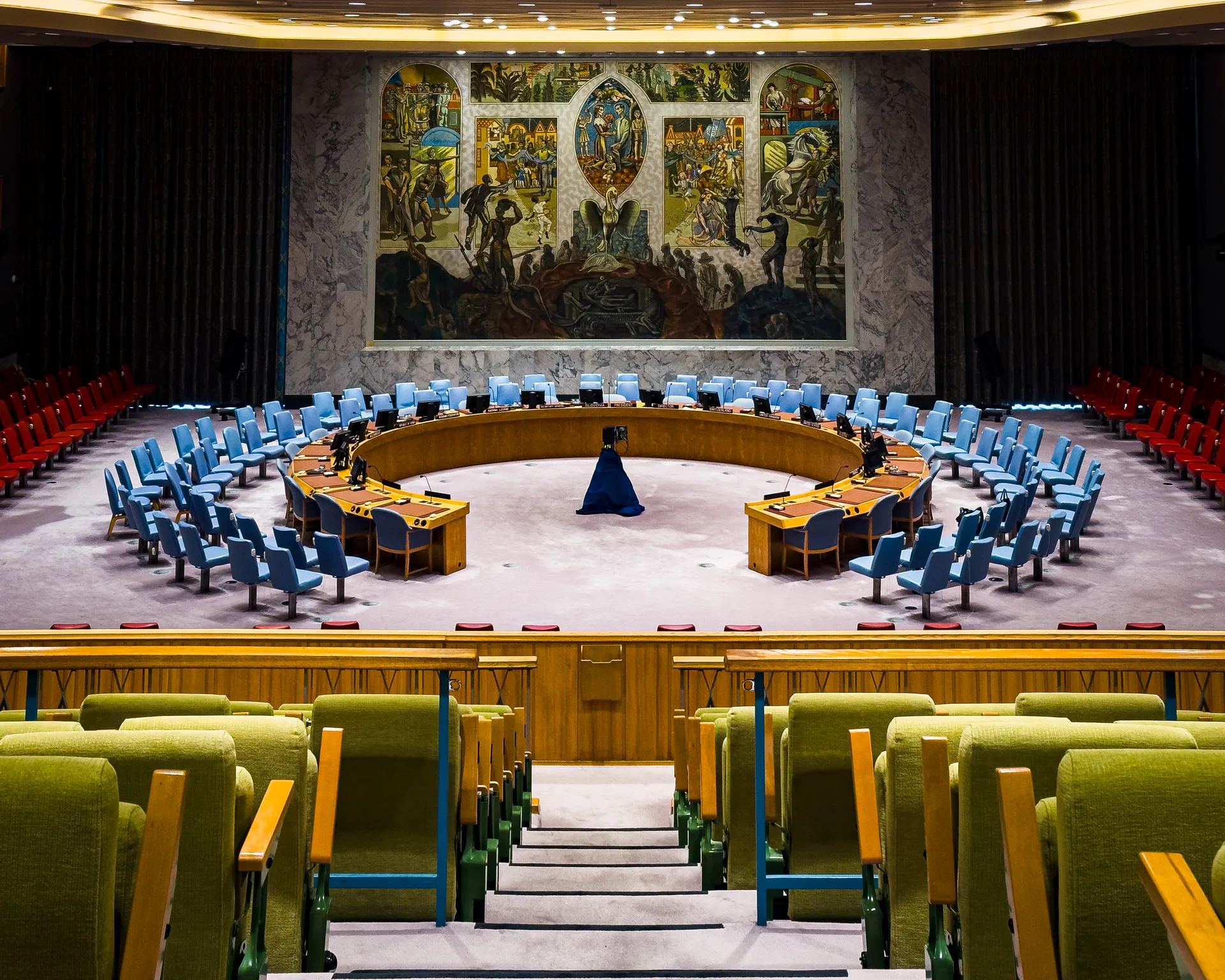
The United Nations Security Council Chamber in New York — the central arena for international peace and security deliberations. Photo: UN Photo
What Is the Security Council?
UN Charter Foundation
The United Nations Security Council (UNSC) was established in 1945 as one of the six principal organs of the United Nations. It holds primary responsibility for maintaining international peace and security under Articles 24-25 of the UN Charter.
Core Authority
The Council's authority derives from Chapters V, VI, VII, and VIII of the UN Charter. Article 24 grants it primary responsibility for international peace, while Article 25 requires all UN members to accept and carry out its decisions.
Why This Matters: The Security Council is the only UN body with the authority to issue legally binding resolutions to member states, making it the most powerful international organization for conflict resolution.
Committee Overview · Structure
Structure & Membership
Permanent Five (P5) Members
Five countries hold permanent seats with veto power: China, France, Russia, the United Kingdom, and the United States. Any substantive resolution requires at least nine affirmative votes and no vetoes from any P5 member.
The Council establishes various committees and working groups to implement its decisions, including sanctions committees, counter-terrorism bodies, and ad hoc tribunals.
The Crisis · Historical Context
Origins of the US-Iran Crisis
1979 Iranian Revolution
The overthrow of the Shah and the establishment of the Islamic Republic marked the beginning of US-Iran hostilities, including the 444-day embassy hostage crisis.
2015 JCPOA
The Joint Comprehensive Plan of Action, endorsed by UN Security Council Resolution 2231, placed limits on Iran's nuclear program in exchange for sanctions relief.
2018 US Withdrawal
The Trump administration withdrew from the JCPOA, reimposing sanctions and beginning a "maximum pressure" campaign against Iran.
2026 Escalation
Repeated military escalations, cyber operations, and attacks on shipping routes have brought the region to the brink of major conflict.
"Conflicts with Iran-aligned groups in Iraq, Syria, Lebanon, and Yemen have created multiple fronts of tension throughout the region."
The Crisis · Nuclear Issue
The Nuclear Dimension
IAEA Monitoring
International Atomic Energy Agency conducts regular inspections of Iran's nuclear facilities
Enrichment Levels
Iran has enriched uranium to 60% purity, close to weapons-grade 90%
"Resolution 2231 endorsed the JCPOA and established a framework for verifiable limits on Iran's nuclear program in exchange for sanctions relief."
Current Concerns: Iran has exceeded JCPOA limits on enrichment levels, stockpile sizes, and centrifuge research, while reducing IAEA access to monitoring sites.
The Crisis · Regional Impact
Regional Ripple Effects
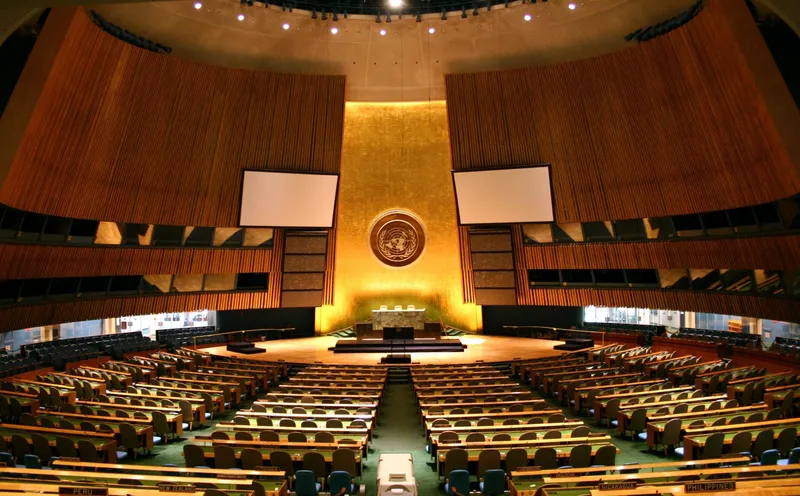
The UN General Assembly Hall where all 193 member states convene — a contrast to the Security Council's exclusive 15-member structure.
Iraq
Iran-aligned militias operate freely, attacking US forces and destabilizing the government. The Popular Mobilization Forces maintain significant military capability.
Syria
Iran supports the Assad regime and maintains military bases, while Hezbollah fighters operate across the border.
Lebanon
Hezbollah, Iran's most powerful proxy, maintains a military arsenal larger than the Lebanese army and influences government policy.
Yemen
The Houthi movement receives Iranian weapons and training, threatening shipping in the Red Sea and Bab el-Mandeb Strait.
Maritime Security
Strait of Hormuz carries ~20% of global oil exports, making it a critical chokepoint
Summary · Key Takeaways
Key Takeaways
UNSC Authority
The Security Council has primary responsibility for international peace and security with binding enforcement powers
Veto Power
P5 members can block any substantive resolution, creating both checks and potential gridlock
Historical Context
US-Iran tensions span over four decades, rooted in the 1979 Revolution and amplified by nuclear disputes
Regional Complexity
Proxy conflicts across multiple countries create a multifaceted crisis requiring comprehensive solutions
Reflection · Discussion
Questions to Consider
Understanding
What are the key differences between Chapter VI and Chapter VII of the UN Charter, and how do they apply to the US-Iran crisis?
Analysis
How has the veto power of P5 members affected the Security Council's ability to address the US-Iran conflict?
Evaluation
Evaluate the effectiveness of the JCPOA as a non-proliferation framework. What were its strengths and weaknesses?
Application
If you were a delegate on the Security Council, what resolution would you propose to address the current crisis? What compromises would you seek?
—— End of Lecture 1 ——
Continue to Lecture 2: Pathways to Peace & The Strait of Hormuz